The four things that drive a Pokémon card's value
- 1Grade
- The single biggest multiplier. The same card as a PSA 10 versus a PSA 8 is routinely a dramatic price difference. Ungraded (raw) cards price at a discount because the buyer takes on grading risk.
- 2Set and printing
- First editions, shadowless printings, and early sets carry premiums. The same character across different sets can differ by orders of magnitude. This is why "charizard pokemon card value" has no single answer: a Base Set PSA 10 Charizard and a modern reprint are different worlds.
- 3The card itself
- Chase cards, alt arts, and low-population cards hold value. Bulk commons and uncommons are usually worth more as a graded-worthy lot check than individually.
- 4Timing
- Pokémon prices move like a market. A card can gain or lose value sharply within a couple of months. That cuts both ways, which matters when deciding whether to sell at all (more on that below).
How to check a card's value, step by step
- 1
If it is PSA graded, start with the cert number.
Every PSA slab has a certification number on the label. Enter it at PSA's cert verification page to confirm authenticity and see PSA's current price estimate for that exact card and grade.
- 2
Check sold prices, not asking prices.
On eBay, filter to Sold items for your card and grade. Asking prices tell you what sellers hope for; sold prices tell you what buyers pay. Recent solds are the closest thing to a true market value.
- 3
Cross-check a price database or value finder.
TCGplayer, price guide sites, and card value scanner apps aggregate market data by set and card. Useful for raw cards and modern sets, but remember they report displayed value, not what a buyer will pay.
- 4
Then apply the cash-value discount.
Whatever displayed value you found, a realistic same-week cash number from a buyer is 70 to 90% of it, minus marketplace fees of 10 to 13% if you sell online yourself.
A slab showing $1,000 of displayed value is realistically an $800 cash card at a strong buyer, or roughly $870 to $900 after fees if you find an online buyer yourself and wait for one.
Know your cards value but don't want to sell?
Here is the option most collectors do not know exists: use the value without giving up the cards.
PledgeApp pays a cash prepayment of 50 to 60% of market value on PSA-graded Pokémon slabs and 50 to 68% on sealed product. Your cards ship insured into vaulted storage. Cash payout within 48 hours of arrival. At the end of a 60, 90, or 120-day term, you can pay back and take everything home. You keep ownership the entire time.
Measured against the real cash value rather than the displayed value, that prepayment is closer than it looks: on the $1,000-displayed card above, a prepayment in the mid-$500s compares against roughly $800 of realizable cash, not $1,000. And unlike selling, if the card appreciates during your term, that upside is still yours.
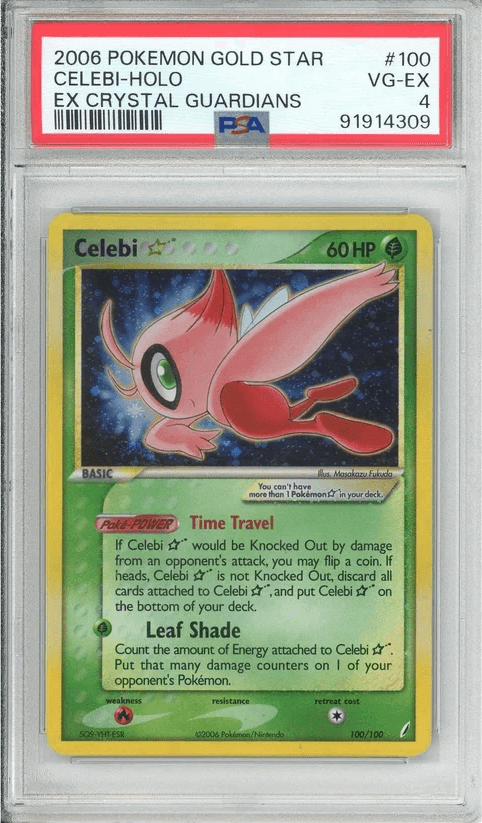
A customer's PSA Goldstar Celebi
$810 → $1,382
June valuation to August PSA estimate
A customer's PSA Goldstar Celebi was valued at $810 in June. He took a prepayment instead of selling, paid it back after 60 days, and took the card home. By August its PSA estimate was $1,382. Selling in June would have cost him that entire rise.
Importantly, PledgeApp.ai will never sell your assets without your express consent. In fact, selling is completely optional. Only when you, the customer, set a Target Payout Price within the Pledge system will the asset get listed for sale.

